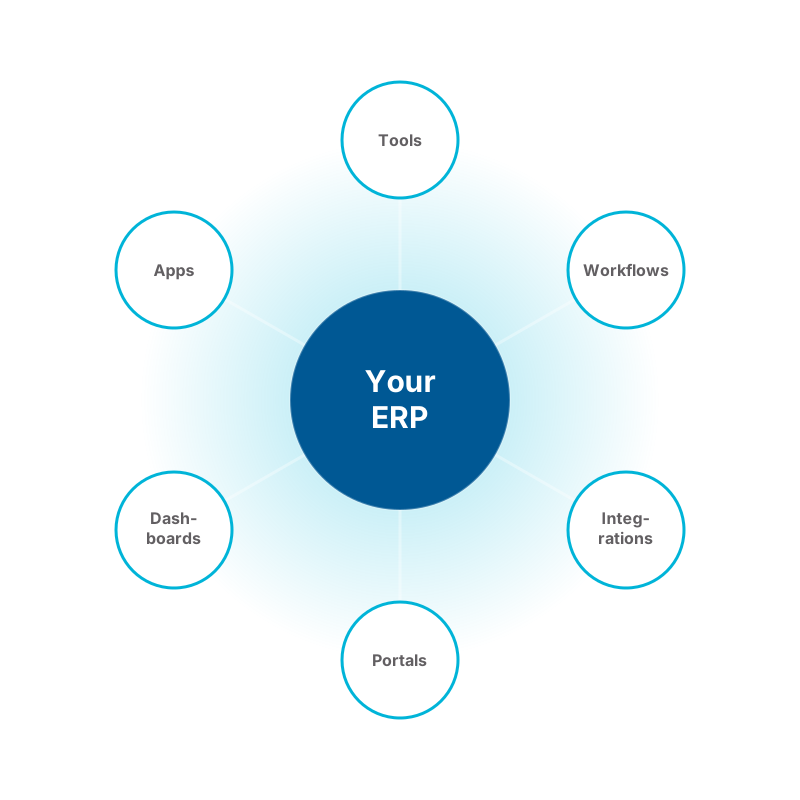
Your ERP does a lot. It's just not everything. The gap between what it covers and what your business actually needs to run tends to get filled with workarounds — and those workarounds add up.
Spreadsheets filling in the gaps your ERP doesn't cover
Duplicate data entry between your ERP and everything else
Machines and shop-floor systems that don't talk to your ERP
Systems that don't talk to each other, so nothing lines up
Reports you have to build by hand every week
Tell us what is happening and what you are trying to improve. We'll ask questions, share an initial perspective, and help determine a practical next step.
Replacing an ERP is expensive, disruptive, and often unnecessary. Most of what feels broken isn't the ERP itself — it's the missing piece around it: the report nobody built, the two systems that don't sync, the workflow still running on a spreadsheet. Extending what you have is usually faster, cheaper, and far less disruptive than a rip-and-replace project.
That's not always true — if your ERP has genuinely outgrown your business, replacing it is the right call.
Purpose-built applications for the specific job your ERP doesn't cover, built around how your team actually works.
Customer and supplier portals that expose the right ERP data without giving away the keys to the whole system.
Real-time visibility built directly from your ERP and shop-floor data, instead of a report someone rebuilds by hand.
Automated processes that remove manual steps between systems, so data moves without someone re-typing it.
Structured approval routing for purchase orders, change orders, and exceptions that today live in email threads.
Production and resource scheduling that reflects what your ERP actually knows, instead of a whiteboard or spreadsheet.
Connecting ERP data directly to PLCs and shop-floor systems, so production data flows both ways automatically.
Two-way sync between your ERP and your online storefront, keeping inventory, pricing, and orders consistent.
Connecting your ERP to the other systems your business runs on, so information doesn't get re-entered by hand.
Extending your ERP isn't the right call for every business. Here are the three paths we see most often — and how to tell which one actually fits yours.
Your ERP still fits the core of how you operate, but specific gaps keep getting patched with spreadsheets, manual entry, or disconnected tools.
The fastest and least disruptive path. Most projects are scoped in weeks, not a company-wide rollout, and your team keeps working in the system they already know.
You've decided the right move is a different off-the-shelf ERP platform — not extending what you have.
We don't sell or implement third-party ERPs. Whichever platform you choose, we can build the integrations, custom tools, and workflows around it so it fits how you actually run your business.
No off-the-shelf platform fits your operation, and you're tired of paying for — and working around — features you'll never use.
A system built specifically for your workflows, with full source code ownership and no per-user licensing fees.
Tell us what is happening and what you are trying to improve. We'll ask questions, share an initial perspective, and help determine a practical next step.
FreedomDev created an ERP-connected shipping application covering truck runs, manifests, pick lists, packing lists, authentication, and existing reporting infrastructure.
FreedomDev connected ERP data directly to manufacturing equipment so mixer PLCs could validate batches and retrieve production information automatically.
FreedomDev built a two-way ERP/eCommerce integration synchronizing products, pricing, inventory, customers, and orders with logging, retries, and reconciliation controls.
FreedomDev expanded a label-processing application to add full product traceability — connecting machine output, material lots, Business Central production orders, and finished-good labels with duplicate-print prevention.
FreedomDev automated the exchange of ERP transaction data with an outside platform, including XML generation, SFTP transfer, returned confirmations, and ERP updates.
FreedomDev brought ERP information, BOMs, orders, opportunities, tasks, and search into a more unified internal business application.
FreedomDev rebuilt a vendor-performance application around an existing enterprise system with SSO, API integration, structured worksheets, image capture, local progress protection, and synchronization.
FreedomDev created an inventory workflow around existing ERP systems and later adapted it to support two warehouse platforms during a facility-by-facility migration.
FreedomDev replaced a legacy job-tracking system with a custom application connecting employees, timecards, purchase orders, jobs, payroll, invoicing, QuickBooks, and reporting.
FreedomDev helped modernize a 20-year-old business application by moving it toward PostgreSQL on Azure while preserving its business logic and replacing a six-hour nightly reporting process.
FreedomDev built a custom inventory and order management system connected to the eBay API, covering purchase orders, receiving, listing creation, pricing, warehouse locations, and order synchronization.
FreedomDev turned recurring Excel files into a structured spend-management application with validation, budgeting, and salesperson reporting.
FreedomDev definitely set the bar a lot higher. Yosef has been outstanding, very easy to work with — we always walk away from conversations feeling like winners. Mason takes the time to understand not just the requirements but why we're doing it that way. I don't think we would have been able to implement that ERP in our Holland, Michigan facility if it wasn't for FreedomDev filling these gaps.
Len A.
IT Applications Manager, Sekisui Kydex
FreedomDev helped us build a custom customer-facing portal that pulled together information from a multitude of sources to make it real-time and user friendly. We're probably saving 20 to 30 hours a week now just because we gave the customer visibility into their equipment. They were able to take our ramblings and turn them into an actual product. Five stars across the board.
Matt K.
Cloud Services Manager, Code Blue
We had Microsoft Excel for this, pen and paper for that, and a third-party app for texting. FreedomDev brought all of that into one closed-loop system. Rachel spent incredible time learning our systems — a crash course on the meat industry. We're definitely getting more done with less time and the same amount of people. It really sets us up for future growth.
Andrew B. & Laura S.
Production Manager & Co-Owner, Byron Center Meats
We start by understanding what your ERP already does well, where the gaps actually are, and which workarounds are costing you the most time.
We design the specific tools, workflows, and integration points needed to close those gaps, scoped in phases so you see value early.
We build the custom applications, automations, and integrations against your actual systems and data.
We test against real data and real workflows before anything goes live, so nothing breaks what already works.
We roll out in phases, minimizing disruption to the systems and people who depend on them every day.
We stay engaged after go-live to support what we built and adjust it as your systems change.