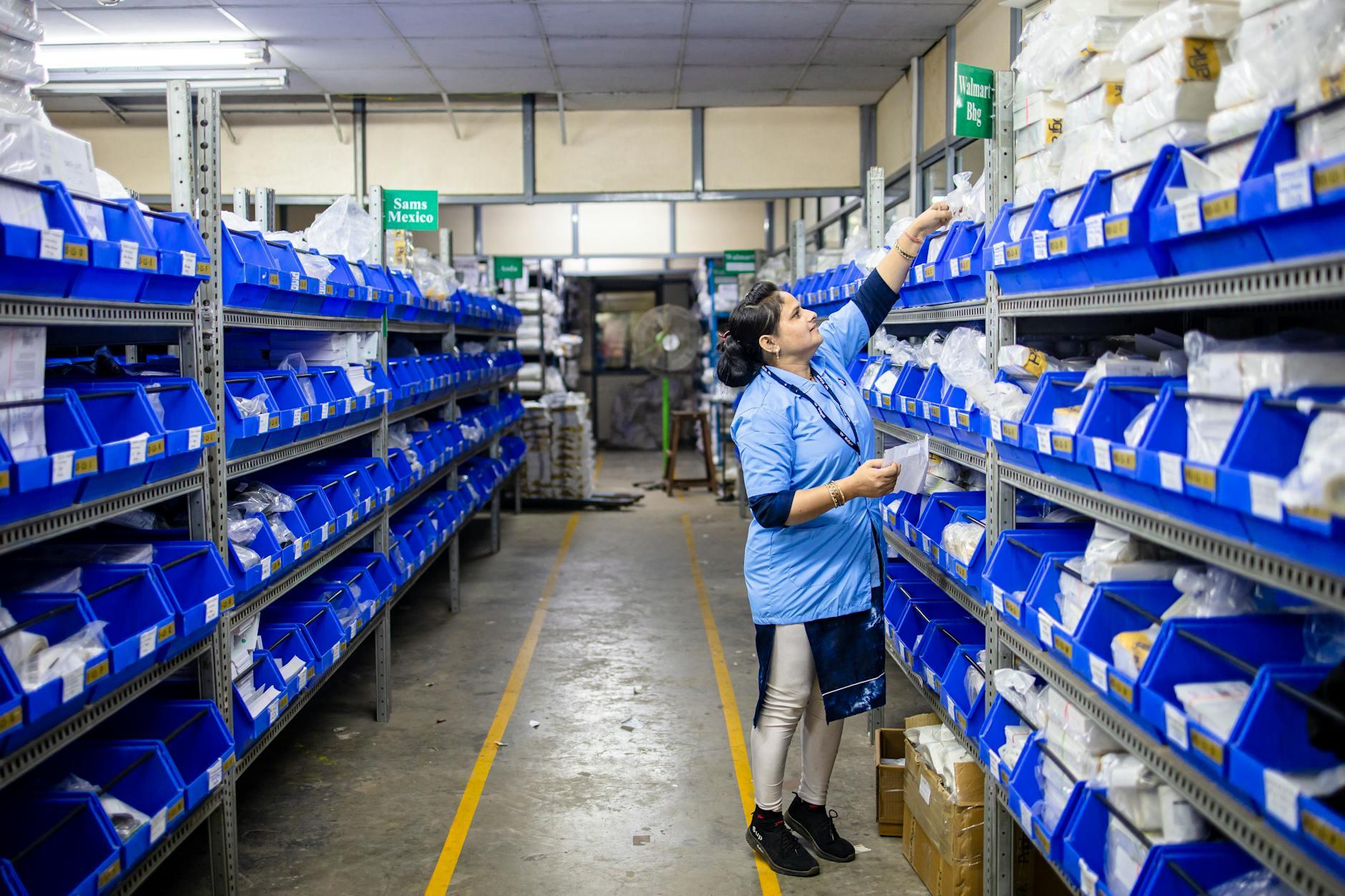
Custom inventory management software solves the problem that hits every mid-market manufacturer, distributor, and multi-location retailer eventually: your ERP's inventory module works fine for accounting but fails at operational reality (multi-bin warehouses, lot/serial tracking, cycle counting, real-time mobile receiving), and the off-the-shelf inventory products either do not integrate cleanly with your ERP or force you into their workflow rather than yours. FreedomDev has built custom inventory systems for manufacturers, distributors, and e-commerce companies for 18+ years. We integrate with Epicor, NetSuite, Acumatica, SAP, Sage, QuickBooks, and Dynamics — we connect to your ERP, we do not replace it. Real-time tracking, automated reordering, multi-location consolidation, ERP synchronization. 30%+ carrying cost reduction is typical year-one impact.
Every company solving inventory the third time hits the same pattern. The first time, it's a spreadsheet. The second time, it's the ERP's inventory module. The third time, it's a custom system because the first two stop working at scale.
**Why ERP inventory modules fail at operational reality:**
**Why off-the-shelf inventory products fail at integration reality:**
Custom inventory software fits the middle: built specifically for your operation, integrated with your existing ERP via clean APIs, designed around how your operators actually work, owned by you as code in your repository.
Tell us what is happening and what you are trying to improve. We'll ask questions, share an initial perspective, and help determine a practical next step.
Custom inventory management software solves the problem that hits every mid-market manufacturer, distributor, and multi-location retailer eventually: your ERP's inventory module works fine for accounting but fails at operational reality (multi-bin warehouses, lot/serial tracking, cycle counting, real-time mobile receiving), and the off-the-shelf inventory products either do not integrate cleanly with your ERP or force you into their workflow rather than yours. FreedomDev has built custom inventory systems for manufacturers, distributors, and e-commerce companies for 18+ years. We integrate with Epicor, NetSuite, Acumatica, SAP, Sage, QuickBooks, and Dynamics — we connect to your ERP, we do not replace it. Real-time tracking, automated reordering, multi-location consolidation, ERP synchronization. 30%+ carrying cost reduction is typical year-one impact.
Most custom inventory projects we ship cover the same five capability sets. Not every project needs all five — discovery identifies which two or three are the actual pain points. **Capability 1: Real-time multi-bin warehouse management.** Tracking items at the bin level, not just the warehouse level. A "bin" can be a physical shelf location, a pallet position, a staging area, or a customer-reserved hold. The system tracks which items are in which bins, when they were put there, and the rules for which bin a new receipt goes into. Typical features: - Multi-pallet receipt processing with directed putaway - Bin-to-bin transfers with full audit trail - Pick-path optimization for order fulfillment (shortest physical route through the warehouse) - Bin replenishment from bulk to pick faces - FIFO/LIFO enforcement at the bin level **Capability 2: Lot and serial number tracking with traceability.** Full lot or serial-number traceability from raw material receipt through finished goods shipment. Required for regulated industries (medical devices, pharmaceutical, automotive PPAP, food safety). Operationally valuable for recall management, warranty tracking, and quality investigation. Typical features: - Lot capture on receipt with vendor lot, internal lot, expiration date - Lot consumption tracking during production - Serial number generation and capture for serialized products - Forward traceability (which finished goods contain this lot?) and backward traceability (which lots went into this finished good?) - Customer recall list generation from a lot number in under 30 seconds **Capability 3: Automated reordering and replenishment.** Min/max-based reorder points are the classic approach but increasingly inadequate. Modern reordering uses demand forecasting, lead-time variability, safety-stock optimization, and supplier-specific reorder rules. Typical features: - Min/max reorder rules at the item-warehouse level (table stakes) - Forecast-based reorder points (calculate ROP from historical consumption + lead time) - Supplier-specific ordering rules (minimum order quantities, multiples, container loads) - Multi-supplier sourcing with preferred-vendor logic - Reorder consolidation (combine items from same supplier into single PO) - ABC analysis (focus reorder rigor on high-velocity items) **Capability 4: Mobile receiving, picking, and counting.** Operator interfaces designed for handhelds (Zebra TC52/TC55, iOS or Android tablets, ring scanners). Workflows match how operators actually work — barcode-driven, glove-friendly, fault-tolerant. Typical features: - Receiving against PO with quantity confirmation and overage handling - Pick-and-pack workflows with confirmation scans - Cycle counting with discrepancy investigation flow before adjustment posting - Putaway directed to bins - Inter-bin transfer - Offline mode (continue working if Wi-Fi drops; sync when reconnected) **Capability 5: ERP integration.** The inventory system is not the source of truth for everything. The ERP owns customer master, item master, purchase orders, sales orders, and accounting. The custom inventory system owns real-time inventory state and operator activity. They need to integrate cleanly. Typical features: - Item master sync from ERP (one-way, ERP authoritative) - Vendor and customer master sync from ERP - Purchase orders pulled from ERP on creation - Inventory transactions posted back to ERP (receipts, transfers, adjustments, issues, completions) - Sales orders pulled from ERP for pick-pack-ship workflow - Financial reconciliation: inventory value in custom system matches ERP inventory accounting at month-end
The "30%+ carrying cost reduction" claim is not vendor-speak. It is the typical year-one outcome from four compounding improvements: **Improvement 1: Inventory accuracy from 85-90% to 98%+.** Cycle counting + bin-level tracking surface and correct the discrepancies that built up over years. Higher accuracy means less safety stock needed to compensate for "we think we have it but maybe we do not." **Improvement 2: Reduced safety stock through forecast-based reordering.** Replacing static min/max with forecast-based reorder points typically reduces average inventory by 15-25% without service-level degradation. The math: safety stock = z * σ * √L, where z is the service-level multiplier, σ is demand variability, and L is lead time. Forecasting accuracy reduces σ; supplier discipline reduces L. **Improvement 3: Slow-mover identification and consolidation.** Custom systems make it trivial to identify items with no movement in 6, 12, 24 months. Mid-market warehouses typically have 10-20% of their inventory dollars in items that have not moved in 12 months — write-down candidates that finance is not aware of without the data. **Improvement 4: Multi-location consolidation visibility.** Companies with multiple warehouses often hold redundant safety stock at each location because they cannot see the network total. A consolidated view enables inter-warehouse transfers before reordering. **Real example, 2024 Michigan distributor (custom inventory system FreedomDev built):** - Pre-system: $4.8M average inventory value, 87% accuracy, 4.2 inventory turns/year, carrying cost ~$1.1M/year (23% of inventory value — typical for mid-market distribution) - Post-system (12 months operational): $3.4M average inventory value, 98% accuracy, 5.7 turns/year, carrying cost ~$780k/year - **Annual savings: ~$320k. Implementation cost: $145k. Payback: 5.5 months.** Numbers vary by industry, item mix, and pre-system baseline. Companies with worse starting points see larger relative improvements. Mature operations see 5-15% improvement rather than 30%. The methodology is the variable that generalizes.
We integrate with every major mid-market ERP. The specifics differ. **Epicor Kinetic.** REST APIs are mature for transactional flows; Epicor BPM (business process management) hooks for event-driven integration. Receiving, issuing, transferring, and adjusting via REST with standard authentication. Custom UD (user-defined) tables to store extended attributes when Kinetic's data model is too rigid. **NetSuite.** SuiteScript-based custom integration or REST web services. NetSuite is well-suited for custom-inventory integration; the SuiteCloud platform was designed for this kind of extensibility. SuiteScript event handlers fire on inventory transactions and can call out to the custom inventory system. **Acumatica.** REST APIs are first-class; Acumatica's contract-based API model is one of the cleanest in the mid-market ERP world. Integration is typically point-to-point REST with webhook patterns for real-time event propagation. **SAP S/4HANA.** Detailed in [`/solutions/sap-custom-api-integration`](/solutions/sap-custom-api-integration). For inventory specifically: BAPI_GOODSMVT_CREATE for goods movements, OData services for material master and inventory queries, IDoc-based asynchronous patterns for high-volume scenarios. **Microsoft Dynamics 365 Business Central.** Modern REST APIs introduced in recent versions; older Dynamics NAV deployments use SOAP web services. Both supported; the API surface is comprehensive. **Sage 100 / Sage 300 / Sage Intacct.** Mixed API maturity across the Sage product line. Sage 100 and 300 require SDK-based integration in many cases; Sage Intacct has modern REST APIs. We have shipped custom inventory integrations for all three. **QuickBooks Enterprise.** Limited API surface for inventory specifically. Custom inventory typically owns operational state and posts summarized transactions to QuickBooks at end-of-shift or end-of-day. Direct integration via the QuickBooks SDK.
A typical custom inventory project runs 16-26 weeks from discovery to production: **Weeks 1-3: Discovery.** Walk the warehouse(s). Interview operators, supervisors, and the controller. Audit the current ERP configuration and existing inventory pain points. Catalog the integrations needed. Identify regulatory requirements (FDA, AS9100, IATF 16949, etc.). Deliverable: a detailed scope document with prioritized capability list. **Weeks 4-6: Architecture and prototyping.** Database design (item master, lot/serial, bin locations, transaction log). Service architecture. ERP integration design. Mobile UX prototypes shown to operators for feedback before development. Deliverable: architecture document, prototype mobile UI, flat-rate build proposal. **Weeks 7-18: Build phase.** Iterative delivery. Receiving and putaway first (highest-volume operator workflow); then picking and shipping; then cycle counting and adjustments; then reporting and analytics. ERP integration ships in parallel with each capability. Weekly demos to your team. **Weeks 19-22: Validation and pilot.** Run the system in pilot mode at one warehouse area or with one product line. Operators use it in earnest while the legacy system continues to be the system of record. Catch edge cases. **Weeks 23-24: Production cutover.** Documented cutover with rollback plan. Inventory reconciliation snapshot before cutover. Active monitoring for 7 days post-cutover with both systems available. **Weeks 25-26: Stabilization.** Remote-available for fast iteration as operators use the system in production. Adjustments to UI, rules, workflows based on actual feedback. **Ongoing: Optional managed support retainer for enhancements and operational support.**
Tell us what is happening and what you are trying to improve. We'll ask questions, share an initial perspective, and help determine a practical next step.